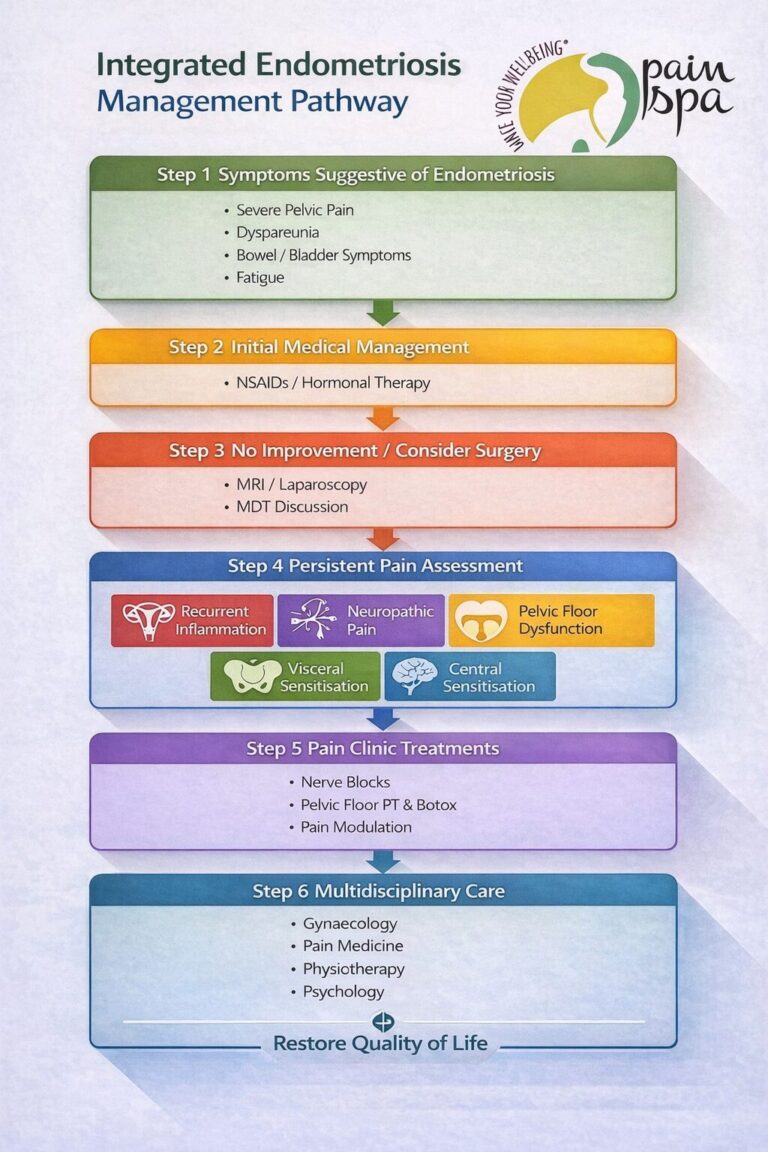
Endometriosis is a chronic, estrogen-dependent inflammatory condition in which tissue similar to the lining of the uterus grows outside the womb, most commonly on the ovaries, pelvic peritoneum, and rectovaginal region. It affects approximately 1 in 10 women of reproductive age and is frequently associated with dysmenorrhoea, deep dyspareunia, infertility, and chronic pelvic pain. While surgical excision and hormonal therapies form the cornerstone of gynaecological management, many women continue to experience significant pain even after apparently successful surgery. This can be particularly distressing when repeat scans show little or no visible endometriosis, leading patients to question why their symptoms persist.
Pain in endometriosis is often multifactorial. In addition to active inflammatory lesions, pain may arise from nerve irritation or entrapment, pelvic floor muscle spasm and myofascial dysfunction, and changes within the nervous system itself, including peripheral and central sensitisation. Understanding these mechanisms is crucial when symptoms continue despite optimal gynaecological treatment. At Pain Spa, we adopt a structured, multidisciplinary approach to assess and address these overlapping pain generators, aiming to improve function and quality of life in women living with persistent endometriosis-related pain.
Endometriosis is a chronic, estrogen-dependent inflammatory condition in which tissue similar to the lining of the uterus (endometrium) grows outside the womb. These deposits most commonly occur on the ovaries, pelvic peritoneum, uterosacral ligaments, rectovaginal septum, bladder, and bowel, but in some cases may affect deeper structures within the pelvis.
Although this tissue resembles normal endometrium, it behaves differently. It responds to hormonal changes during the menstrual cycle, leading to cyclical inflammation, swelling, and sometimes bleeding within confined pelvic spaces. Over time, this can result in scarring, adhesions, distortion of pelvic anatomy, and in some women, the development of ovarian cysts known as endometriomas.
Endometriosis affects approximately 10% of women of reproductive age and is found in a much higher proportion of women with chronic pelvic pain or infertility. The severity of symptoms does not always correlate with the amount of visible disease. Some women with minimal disease may experience severe pain, while others with extensive disease may have relatively mild symptoms.
Importantly, endometriosis is not simply a “lesion-based” condition. It is now understood as a complex inflammatory and neurobiological disorder involving immune activation, altered hormone responses, and changes in the way pain signals are processed within the nervous system. This broader understanding is particularly relevant when pain persists despite surgical removal of visible disease.
Pain in endometriosis is complex and often multifactorial. While visible endometriotic lesions can contribute to symptoms, the intensity and persistence of pain cannot always be explained by the amount of disease seen on scans or at surgery.
Several overlapping mechanisms may be involved:
Endometriotic tissue responds to hormonal changes during the menstrual cycle. This can lead to cyclical swelling, bleeding, and local inflammation within confined pelvic spaces. Inflammatory mediators such as prostaglandins and cytokines sensitise nearby nerve endings, lowering the threshold for pain and contributing to dysmenorrhoea and deep pelvic discomfort.
Endometriosis can grow near or around pelvic nerves, including the uterosacral ligaments, pudendal nerve, sacral plexus, or other somatic nerves. In some cases, lesions may infiltrate or irritate these nerves directly. This can produce neuropathic-type pain — burning, stabbing, shooting, or radiating pain — and may lead to symptoms extending into the buttocks, groin, or legs.
Chronic pelvic pain often leads to protective muscle guarding. Over time, the pelvic floor muscles can become tight, overactive, and develop myofascial trigger points. These tight bands of muscle can themselves become a significant source of ongoing pain, even if the original inflammatory stimulus has been treated. Pelvic floor hypertonicity is frequently overlooked but can be a major contributor to persistent symptoms.
With ongoing inflammation or repeated pain episodes, the nervous system can become sensitised. Peripheral sensitisation occurs when local nerve endings become more reactive. Central sensitisation occurs when the spinal cord and brain amplify incoming pain signals. In this state, the nervous system remains in a “high-alert” mode, meaning pain can persist even after lesions have been removed or inflammation has reduced.
Pelvic organs share neural pathways. Irritation from endometriosis affecting one organ (for example, the uterus or bowel) can increase sensitivity in neighbouring structures. This may explain why some women experience bladder pain, bowel symptoms, or diffuse pelvic discomfort even when imaging findings are limited.
One of the most important aspects of endometriosis-related pain is that symptom severity does not necessarily correlate with the amount of visible disease. A woman with minimal visible endometriosis may experience severe pain due to nerve sensitisation or pelvic floor dysfunction, while another with extensive disease may report fewer symptoms.
Understanding these mechanisms is essential when pain persists despite apparently successful surgery or when MRI scans show little active disease. Persistent pain does not mean the symptoms are “imagined” — it reflects the complex interaction between inflammation, nerves, muscles, and the central nervous system.
The symptoms of endometriosis can vary widely between individuals. Some women have minimal symptoms, while others experience severe and life-altering pain. Importantly, the pattern and severity of symptoms do not always correlate with the amount of visible disease.
Dysmenorrhoea (Painful Periods)
Severe menstrual cramps that may begin before bleeding starts and persist for several days. Pain is often described as deep, throbbing, or cramping and may not respond adequately to standard painkillers.
Chronic Pelvic Pain
Non-cyclical pelvic pain lasting more than six months. This may be constant or fluctuate in intensity and can significantly impact daily function and quality of life.
Deep Dyspareunia (Pain During Intercourse)
Pain felt deep within the pelvis during or after intercourse, particularly in cases involving the uterosacral ligaments, rectovaginal septum, or posterior pelvis.
Bowel Symptoms
Pain during bowel movements (dyschezia), bloating, constipation, or cyclical worsening of gastrointestinal symptoms. In some cases, pain may radiate towards the rectum or lower back.
Bladder Symptoms
Pain with bladder filling, urinary urgency, or discomfort during urination, particularly if endometriosis involves the bladder or surrounding structures.
Infertility
Endometriosis is associated with reduced fertility in some women, although many women with endometriosis conceive naturally.
In addition to typical gynaecological symptoms, some women experience:
These patterns may indicate involvement of pelvic nerves or secondary myofascial pelvic floor dysfunction rather than active inflammatory lesions alone.
The severity of symptoms does not reliably reflect the extent of disease seen on scans or during surgery. Some women with minimal visible endometriosis experience severe pain, while others with extensive disease may report fewer symptoms. This reflects the complex interaction between inflammation, nerves, muscles, and the central nervous system.
Surgical excision of endometriosis is an important and often effective treatment. For many women, removing visible lesions reduces inflammation and improves symptoms. However, a significant proportion of patients continue to experience pelvic pain despite apparently successful surgery.
This does not mean that the surgery was unnecessary or poorly performed. Rather, it reflects the complex and multifactorial nature of endometriosis-related pain.
Several reasons may explain why pain persists:
Endometriosis is a chronic, estrogen-dependent condition. Even after thorough surgical excision, new lesions can develop over time. Recurrence rates vary depending on the extent of disease, surgical technique, hormonal suppression, and individual biological factors.
In some cases, recurrent inflammatory activity may contribute to returning symptoms. However, recurrence does not explain all persistent pain, particularly when imaging shows no clear new disease.
The amount of endometriosis seen at surgery does not always correlate with the severity of pain. Some women with minimal disease experience severe symptoms, while others with extensive disease report less pain. Removing visible lesions does not automatically reverse changes that may already have occurred within nerves or the central nervous system.
Repeated cycles of inflammation can sensitise local nerve endings (peripheral sensitisation). Over time, the spinal cord and brain may also become more reactive to pain signals (central sensitisation).
In this state, the nervous system remains in a heightened “protective” mode. Even if inflammatory lesions are removed, pain pathways may continue to generate amplified signals.
Chronic pelvic pain often leads to protective muscle tightening. The pelvic floor muscles may become overactive and develop trigger points. These tight, hypersensitive muscles can themselves become a major source of ongoing pain.
Surgery does not directly address muscle spasm or myofascial dysfunction, which may continue to drive symptoms after lesion removal.
Endometriosis may irritate or involve pelvic nerves. Even after excision, residual nerve irritation, scarring, or altered nerve signalling can result in neuropathic-type pain — such as burning, shooting, or radiating discomfort.
Surgery can sometimes lead to scar formation. Adhesions may contribute to altered pelvic mechanics or ongoing nerve sensitivity in some patients.
Persistent pain after surgery does not mean that symptoms are imagined, exaggerated, or purely psychological. It reflects the complex interaction between inflammation, nerves, muscles, and the central nervous system.
A broader pain-focused assessment is often required when symptoms continue despite apparently successful gynaecological treatment.
Many women with endometriosis-related pain undergo repeat MRI scans after surgery or during ongoing symptoms. When these scans show little or no visible disease, it can be deeply frustrating and distressing. Patients may feel confused about why pain continues when imaging appears “normal.”
There are several important reasons why this can happen.
MRI is excellent at identifying larger endometriomas and deep infiltrating disease. However, it may not detect:
A normal MRI does not exclude the possibility of small or superficial lesions.
Even when inflammatory lesions have resolved or been removed, pain pathways may remain sensitised. Repeated inflammation over months or years can lead to:
In this situation, the nervous system continues to generate pain signals despite the absence of visible structural disease.
Pelvic floor muscle overactivity, trigger points, and myofascial dysfunction are common in women with chronic pelvic pain. These muscle-related pain generators do not appear on routine MRI scans.
Tight, overactive pelvic muscles can produce deep aching pain, dyspareunia, bowel discomfort, and bladder symptoms — even when imaging is normal.
Pelvic nerves may remain irritated or hypersensitive following previous inflammation or surgery. Neuropathic pain does not always correlate with visible structural abnormalities on imaging.
Burning, shooting, radiating, or electric-type pain can occur even when scans appear normal.
A normal MRI does not mean that pain is not real. It simply means that no large structural abnormality is visible.
Persistent pain often reflects changes in how the nervous system, pelvic muscles, and surrounding tissues are functioning — rather than what can be seen on a scan.
Understanding this distinction is essential in guiding appropriate treatment and avoiding repeated investigations or unnecessary surgery.
Endometriosis-related pain is rarely due to a single cause. In many women, several overlapping mechanisms contribute to ongoing symptoms. Identifying which pain generators are active is essential in guiding effective treatment.
Below is a structured overview of the main mechanisms involved.
Active endometriotic implants produce inflammatory mediators such as prostaglandins and cytokines. These chemicals sensitise nearby nerve endings and contribute to:
This type of pain is often hormone-responsive and may improve with surgery or hormonal suppression.
Endometriosis may involve or irritate pelvic nerves, including:
Nerve-related pain may feel:
Chronic pelvic pain frequently leads to protective muscle tightening. Over time, the pelvic floor muscles may become overactive and develop trigger points.
Myofascial pain may cause:
This muscular component is common but often under-recognised. It does not show on scans and is not directly treated by surgery.
Pelvic organs share neural pathways. Inflammation affecting one organ can increase sensitivity in adjacent structures. This may explain:
This cross-talk between organs can perpetuate pain even when individual structures appear normal on imaging.
With ongoing inflammation or repeated pain episodes, the nervous system may become amplified. In central sensitisation:
Women may experience heightened sensitivity, fatigue, poor sleep, and fluctuating pain patterns. Central sensitisation does not mean pain is psychological — it reflects neurobiological changes in how pain is processed.
Effective treatment depends on recognising which mechanisms are active.
For example:
A lesion-focused strategy alone may not address the full picture.
Investigations are an important part of assessing pelvic pain. However, it is equally important to understand their limitations, particularly in chronic endometriosis-related pain.
Transvaginal Ultrasound
A high-quality ultrasound performed by an experienced operator can detect:
Ultrasound is often the first-line imaging tool.
MRI Scan
MRI is particularly useful for identifying:
MRI provides excellent structural detail and is helpful when planning surgery or evaluating suspected deep disease.
Laparoscopy
Surgical visualisation remains the gold standard for diagnosing endometriosis. It allows both confirmation and treatment of visible lesions.
However, even laparoscopy may not fully explain persistent pain, particularly when inflammation has triggered nerve sensitisation or muscular dysfunction.
Investigations are designed to detect structural abnormalities. They do not reliably detect:
As a result, scans may appear “normal” even when symptoms are significant and very real.
When pain persists despite normal imaging, it can be tempting to repeat scans. While this may sometimes be appropriate, repeated structural investigations do not always provide new answers if the primary drivers of pain are muscular or neurobiological rather than anatomical.
A shift from “What does the scan show?” to “What mechanisms are maintaining the pain?” is often more productive in chronic cases.
In persistent pelvic pain, a comprehensive clinical assessment may include:
This broader approach helps identify which pain generators are active and guides targeted treatment.
Normal investigations do not invalidate symptoms.
They simply indicate that no major structural abnormality is visible.
Chronic pelvic pain in endometriosis often reflects a combination of inflammatory, muscular, nerve-related, and central mechanisms — many of which cannot be seen on routine scans.
The primary aim of medical treatment in endometriosis is to suppress ovarian hormone production, reduce inflammation, and limit progression of endometriotic lesions. Hormonal therapy is often used as first-line treatment, particularly when fertility is not an immediate priority.
Non-steroidal anti-inflammatory drugs (NSAIDs) and paracetamol may help reduce menstrual pain by decreasing prostaglandin-mediated inflammation. However, they are often insufficient for moderate to severe disease.
Hormonal therapy aims to suppress ovulation and reduce estrogen stimulation of endometriotic tissue.
Common options include:
These treatments can reduce cyclical inflammation and are effective for many women. However, they may be limited by side effects, contraindications, or incomplete symptom relief.
Laparoscopic excision or ablation of visible endometriotic lesions may reduce pain and improve fertility in selected cases. Surgery is particularly important in:
However, as discussed earlier, surgery does not always resolve pain completely, particularly when central sensitisation or pelvic floor dysfunction has developed.
Medical and surgical treatments are directed primarily at treating endometriotic disease.
When pain persists despite optimal gynaecological management, it may indicate that additional pain mechanisms are active. In these cases, a structured pain-focused assessment becomes essential.
When pelvic pain persists despite appropriate medical or surgical management of endometriosis, a structured pain-focused approach may be required. The aim is not only to reduce pain intensity, but also to improve function, quality of life, and confidence in movement.
Treatment is individualised according to the dominant pain generators identified during assessment.
If nerve irritation or neuropathic features are present, targeted image-guided nerve blocks may be considered. Depending on clinical findings, this may include:
These procedures can help reduce nerve irritation and, in some cases, break the cycle of persistent pain amplification.
When myofascial pelvic floor dysfunction is identified, local anaesthetic trigger point injections may help relax overactive muscle bands and reduce deep pelvic pain.
These injections are directed at specific areas of muscular tension contributing to symptoms such as dyspareunia, rectal pressure, or sitting intolerance.
In selected cases of significant pelvic floor muscle overactivity, botulinum toxin injections may be considered.
Botulinum toxin works by temporarily reducing excessive muscle contraction and may help in patients with:
This is usually combined with physiotherapy to optimise outcomes.
When central or peripheral sensitisation is contributing to symptoms, medications targeting neuropathic pain pathways may be considered as part of a broader management plan.
These are used carefully and individualised to each patient’s clinical profile.
Specialist pelvic health physiotherapy is a cornerstone of treatment when muscle overactivity, guarding, or movement-related pain is present.
Therapy may include:
Chronic pelvic pain can alter the way the nervous system processes threat and safety signals. Pain-focused psychological approaches do not imply that pain is “in the mind.” Rather, they help:
This may involve cognitive behavioural approaches, pain education, or trauma-informed therapy where appropriate.
Endometriosis-related pain often requires coordinated care between:
No single treatment suits every patient. The goal is to identify the dominant pain drivers and address them in a structured, stepwise manner.

0117 2872383 clinic@painspa.co.uk
Get In Touch
© Pain Spa 2026
Website by Eldo™