
Understanding Diagnostic Medial Branch Blocks and Radiofrequency Treatment for Low Back Pain

Diagnostic Lumbar Medial Branch Blocks and Radiofrequency Denervation for Mechanical Low Back Pain
Key idea: A diagnostic medial branch block is a “test injection.” If your usual back pain improves while the local anaesthetic is working, it strongly suggests the facet joints are the main source of pain and you may be suitable for radiofrequency denervation (radiofrequency ablation).
What this means for you: We confirm the pain source first, so any longer-lasting treatment is targeted and evidence-based.
Understanding Mechanical Low Back Pain
Mechanical low back pain is one of the most common causes of persistent back pain and is often related to wear-and-tear changes in the spine. One important and frequently overlooked source of this pain is the lumbar facet joints.
Why this matters: Different structures in the lower back can cause similar symptoms, so a careful diagnostic approach is essential before deciding on longer-lasting treatments.
Anatomy of the Lower Back and Facet Joints
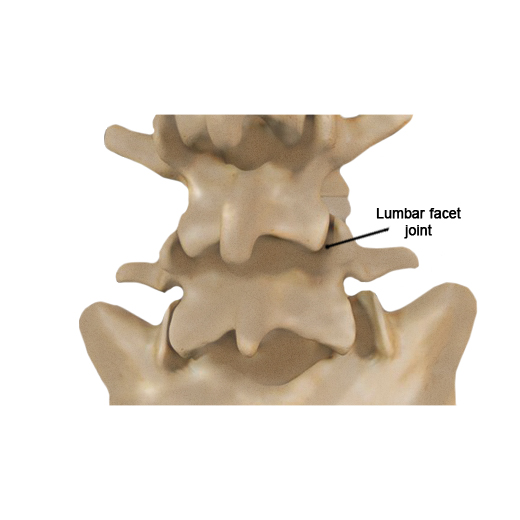
The lumbar spine is made up of vertebrae stacked on top of each other, separated by discs at the front and connected by paired facet joints at the back. The facet joints act like small hinges, allowing controlled movement while providing stability.
Over time, arthritis, degeneration, or repetitive strain can irritate these joints and cause pain.
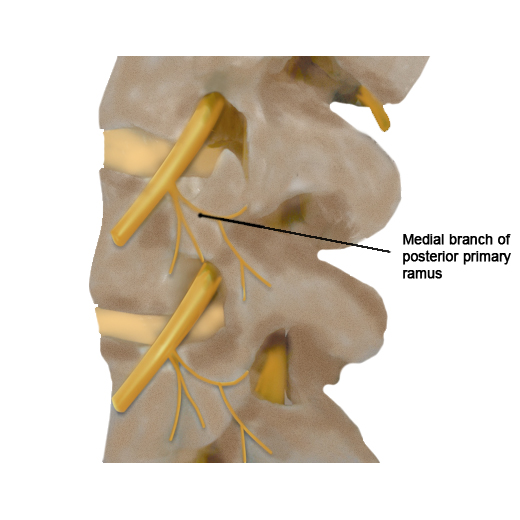
Nerve supply: Each facet joint is supplied by tiny nerves called medial branches (from the dorsal rami). These are sensory nerves that carry pain signals from the facet joints. They do not control leg strength or movement.
Why this matters: Because the medial branches are sensory only, we can target them for diagnosis and treatment without affecting leg strength or movement.
What Are Diagnostic Lumbar Medial Branch Blocks?
A diagnostic lumbar medial branch block is a carefully targeted injection used to confirm whether the facet joints are the source of your back pain.
We inject a small amount of local anaesthetic around the medial branch nerves that supply the suspected painful facet joints.
How it works: While the local anaesthetic is working, the medial branch nerves are temporarily unable to transmit pain signals from the facet joints.
Expected duration: The local anaesthetic typically lasts for around 6–8 hours. Any benefit from a diagnostic medial branch block is therefore expected to occur during this time window.
Pain assessment: We ask patients to assess their usual pain during this period only. If your pain clearly improves while the anaesthetic is active, this strongly suggests the facet joints are the source of pain. Once the anaesthetic wears off, the pain would usually be expected to return.
Important: Occasionally, some patients notice improvement that lasts longer than expected, sometimes for several days or even a few weeks. This can happen due to temporary calming of irritated tissues or reduced muscle spasm, but it does not change the diagnostic purpose of the injection.
Key point: The diagnostic value of the injection is based on pain relief during the anaesthetic window, not on longer-term improvement.
Interpreting the Results: Positive vs Negative
If the block is positive (pain improves): This means the facet joints are very likely to be a major cause of your pain. You may be a suitable candidate for radiofrequency denervation, which aims to provide longer-lasting relief.
If the block is negative (pain does not improve): This suggests there are other pain generators, such as the discs, ligaments, muscles, sacroiliac joints, or nerves.
Why this matters: A negative test is still useful—it helps us avoid unnecessary procedures and redirects us to the most likely pain source.
What Is Radiofrequency Denervation (Radiofrequency Ablation)?
Radiofrequency denervation is a targeted treatment designed to provide longer-term pain relief for confirmed facet joint pain.
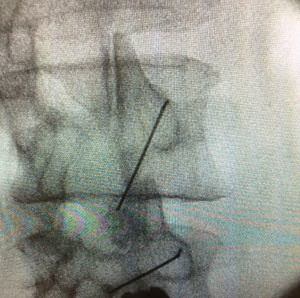
Using fluoroscopy (real-time X-ray guidance), specialised needles are placed precisely next to the medial branch nerves.
Heating to ~80°C: The nerve is gently heated to around 80°C to disrupt its ability to transmit pain signals. This “stuns” the nerve so pain signals from the facet joints are reduced.
Safety: These nerves are sensory only, so treating them does not cause weakness or paralysis.
What to expect: If successful, pain relief can last anywhere from 6 months to 2 years (sometimes longer), depending on how quickly the nerves regenerate.

Why Radiofrequency May Not Work in Some Cases
Even with a positive diagnostic block, radiofrequency treatment may not help everyone. One common reason is that some patients have more than one pain generator, such as a mix of facet pain, disc-related pain, sacroiliac joint pain, and muscular pain.
Severe degenerative changes can alter normal anatomy and make accurate targeting more challenging, and nerve anatomy can vary between individuals.
Important: Limited benefit does not mean “nothing can be done.” It usually means we need to reassess and tailor a broader plan to the full clinical picture.
Expertise at Pain Spa
At Pain Spa, Dr Krishna has extensive experience in performing diagnostic spinal injections and radiofrequency denervation under fluoroscopic guidance.
Radiofrequency denervation is a technically demanding procedure. A detailed understanding of fluoroscopic anatomy is essential, especially in patients with significant degenerative changes where landmarks can be distorted.
Why this matters: Accurate needle placement is critical for both safety and effectiveness, which is why radiofrequency treatment should be performed by experienced clinicians such as Dr Krishna.
Summary
Diagnostic lumbar medial branch blocks help confirm whether facet joints are the main cause of mechanical low back pain by temporarily stopping pain signals from those joints.
If the test is positive, radiofrequency denervation can provide longer-lasting relief by reducing pain transmission through sensory nerves that supply the facet joints.
Important: If the test is negative, other pain generators such as discs, ligaments, muscles, sacroiliac joints, or nerves are more likely, and we can guide you to the most appropriate next step. Please contact Pain Spa at clinic@painspa.co.uk or via our website www.painspa.co.uk.