
Severe Coccyx Pain Successfully Treated with Ganglion Impar Block and Pulsed Radiofrequency
Case Study Series
When sitting becomes impossible: one woman’s journey back from refractory coccyx pain
How a ganglion impar block followed by pulsed radiofrequency ablation gave one woman her life back — after months of being unable to sit, sleep, or move freely
Caroline — Age 59, England
Former small business owner ● Self-pay patient
Failed response from orthopaedic team
Significant functional impairment
Substantial improvement post-PRF
The Presentation
Months of unrelenting pain with no comfortable position
Caroline, a 59-year-old woman from the South West of England, presented to PainSpa in the autumn of 2025 with severe and persistent coccyx pain that had developed over the preceding months. There was no clear single precipitating event; the pain had begun insidiously in mid-2025 and progressively worsened over the weeks that followed, becoming constant, intense, and deeply disabling.
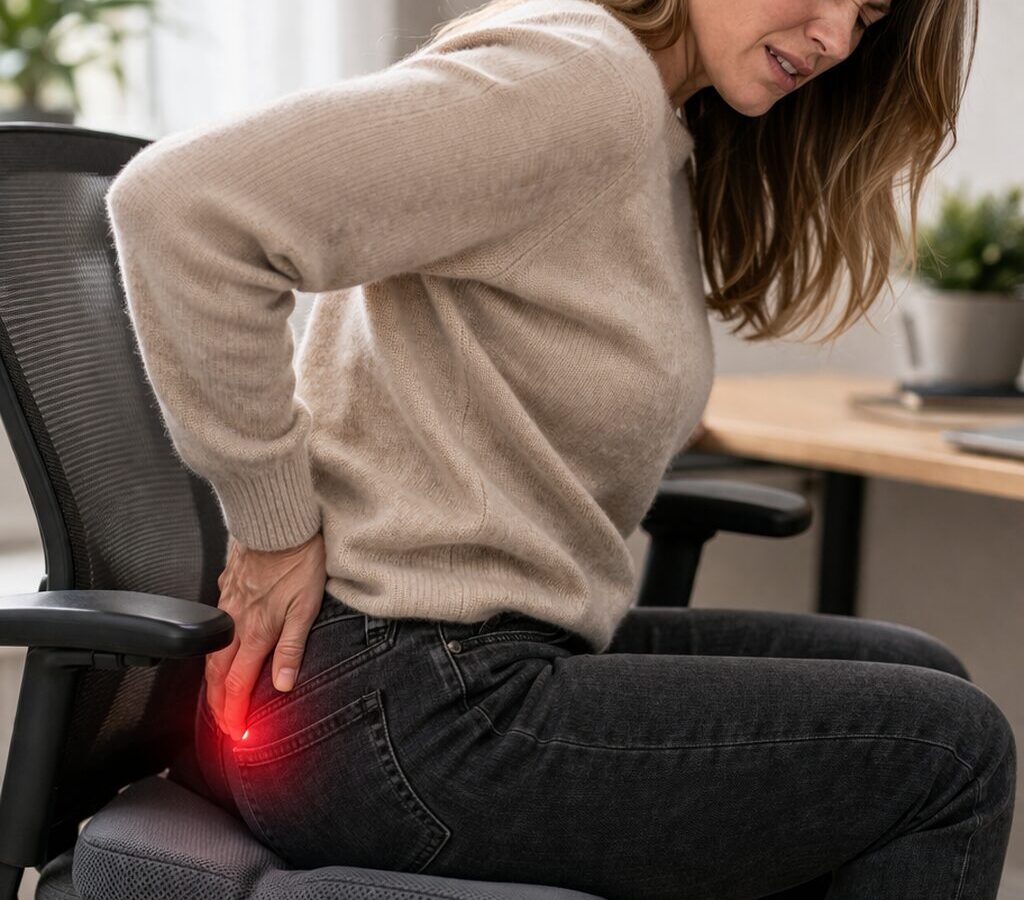
The pain was sharply localised to the coccyx and was exacerbated dramatically by sitting — even for very short periods of less than two minutes. Lying on her back was equally agonising, and as a result she had developed a complex arrangement of pillows and positioning strategies simply to achieve any rest at night. Standing provided partial relief, but walking and any significant movement reliably aggravated the pain. In her own words, there was simply no comfortable position.
The impact on her daily life was profound. She had previously run her own business but was now functionally restricted across almost every domain — unable to sit through meals, car journeys, or social occasions, and severely limited in her independence. Sleep disturbance and persistent pain had taken a significant toll on her mood and overall wellbeing.
She had been assessed and managed by the orthopaedic team prior to her PainSpa referral, without any meaningful improvement in her symptoms. She was managing her pain with Naproxen and Oxycodone on an as-needed basis, alongside Mirtazapine for sleep. Despite this medication burden, her pain remained severe and her function remained significantly compromised.
On clinical examination, there was marked tenderness over the sacrococcygeal junction and the upper coccyx, confirmed on ultrasound assessment. There was no tenderness over the lumbar spine, sacroiliac joints, piriformis muscles, or buttocks bilaterally — pointing clearly to the coccyx as the primary pain source and ruling out alternative structural contributors.
Functional Impact
The hidden burden of coccyx pain
Coccyx pain is frequently underestimated — yet for those who experience it severely, it penetrates every corner of daily life. Caroline’s presentation illustrates how completely this condition can strip away function, independence, and quality of life when it becomes refractory.
Physical — Sitting
Unable to sit for more than moments
● Sitting time limited to under two minutes before pain became unbearable
● Unable to sit through meals, car journeys, or social occasions
● Driving and passenger travel severely curtailed
Physical — Sleep & Rest
No restful position available
● Lying on her back was intensely painful
● Required a complex arrangement of pillows and positioning aids
● Sleep significantly disrupted despite medication
Functional & Social
Life significantly restricted
● Unable to sustain her previous business activities
● Reduced mobility and independence in everyday tasks
● Social withdrawal due to inability to sit or participate comfortably
Psychological
Mood and wellbeing affected
● Persistent pain taking a significant toll on mood and emotional wellbeing
● Frustration and distress compounded by failure of prior treatment
● Quality of life severely diminished across all domains
Caroline had been assessed and treated by the orthopaedic team before presenting to PainSpa, without meaningful improvement in her symptoms. This is a recognised pattern in refractory coccygodynia: when the ganglion impar, rather than local tissue inflammation alone, is the dominant pain generator, conventional orthopaedic approaches are unlikely to provide sustained relief.
The Treatment Journey
A stepwise, evidence-informed approach
Dr Krishna’s approach to Caroline’s case was methodical and transparent — taking a thorough history, examining her carefully, and constructing a management plan that combined appropriate interventional treatment with honest discussion of the limitations of each option and the broader role of rehabilitation in long-term recovery.
Initial Consultation
Comprehensive assessment and management plan
Dr Krishna conducted a detailed consultation via videolink, taking a thorough history and arranging an in-person clinical examination shortly afterwards. Examination confirmed marked sacrococcygeal tenderness on palpation, confirmed with ultrasound, with no involvement of the lumbar spine or sacroiliac joints. Having already had an unsuccessful response from the orthopaedic team, Caroline was assessed as a suitable candidate for a ganglion impar block — a targeted intervention to interrupt pain signals transmitted through this key autonomic structure. The stepwise plan was clearly explained: if the block produced a positive response, pulsed radiofrequency ablation (PRF) would be the next step to achieve more sustained relief.
Day Case Procedure
Ganglion impar block under fluoroscopy — excellent contrast spread
Caroline attended the day case suite at the Chesterfield Nuffield Health Hospital in Bristol, where Dr Krishna performed the ganglion impar block under fluoroscopic guidance with local anaesthetic and steroid. Contrast imaging confirmed excellent spread to the ganglion impar, ensuring accurate and effective drug delivery to the target structure. The immediate post-procedure period was encouraging: Caroline was able to sit comfortably in the hospital for the first time in months. When she arrived home, she sat for around half an hour — a duration that would previously have been impossible.
Day After Procedure
Initial relief short-lived — pain returned overnight
Despite the encouraging immediate response, Caroline’s pain returned to its baseline level the following day. This pattern — a dramatic but transient improvement from the local anaesthetic component of the block, followed by return of symptoms before the steroid takes lasting effect — is recognised in coccygodynia management. It confirmed that the ganglion impar was a significant pain generator in her case, while also establishing that she was an appropriate candidate for pulsed radiofrequency ablation to achieve more durable relief.
Definitive Procedure
Pulsed radiofrequency ablation of the ganglion impar
Having confirmed both a positive response to the diagnostic block and the appropriateness of escalating treatment, Caroline underwent pulsed radiofrequency ablation (PRF) of the ganglion impar at the Nuffield Health Bristol Hospital. PRF is a specialist neuromodulation technique that delivers controlled bursts of radiofrequency energy to modulate pain-transmitting nerve fibres without causing tissue destruction. Under fluoroscopic guidance, Dr Krishna placed the needle with precision confirmed on imaging, and the PRF treatment was delivered to the ganglion impar. The procedure was performed as a day case.
Post-Procedure Follow-Up
Substantial and sustained improvement reported
Following the PRF procedure, Caroline reported a significant and sustained improvement in her coccyx pain. She was able to sit for considerably longer periods, sleep more comfortably, and move with greater freedom than she had experienced in many months. The sustained nature of the improvement — in contrast to the short-lived response from the block alone — confirmed the value of the stepwise approach and the appropriateness of PRF as the definitive intervention in her case. A follow-up appointment was scheduled at eight weeks to formally assess her progress.
The PainSpa Approach
Four pillars of coccyx pain management at PainSpa
Managing refractory coccygodynia requires more than a single procedure. Dr Krishna’s approach is grounded in a structured, multi-layered framework — combining precise interventional treatment with honest expectation-setting and a clear pathway toward rehabilitation and long-term recovery.
Thorough clinical assessment
A detailed history, careful examination, and targeted imaging to identify the precise pain generator and rule out alternative sources before any intervention is considered.
Stepwise interventional treatment
A diagnostic ganglion impar block first to confirm the pain generator and assess response — then pulsed radiofrequency ablation to deliver sustained, durable relief without tissue destruction.
Honest expectation-setting
Clear discussion of what each procedure can and cannot achieve, including the possibility of a temporary flare-up, the risk of incomplete response, and the importance of rehabilitation alongside intervention.
Rehabilitation & long-term recovery
Interventional treatment is not the whole answer. A rehabilitative approach — with physiotherapy and psychology input where appropriate — is the mainstay of sustainable long-term recovery.
Outcome
What changed for Caroline following PRF
The combination of a diagnostic ganglion impar block followed by pulsed radiofrequency ablation produced a substantial and sustained improvement in Caroline’s symptoms — the kind of change that conventional management had been unable to achieve. For someone who had spent months unable to perform the most basic daily activities, the improvements were clinically and personally significant.
Key improvements following pulsed radiofrequency ablation
● Significant and sustained reduction in coccyx pain — in contrast to the short-lived response from the initial block alone
● Able to sit for considerably longer periods, restoring basic daily function including meals, travel, and social activities
● Improved sleep quality, no longer reliant on a complex arrangement of pillows and positioning aids
● Greater freedom of movement and improved independence in everyday activities
● Meaningful improvement in overall quality of life and wellbeing
● A clear platform from which to engage more effectively with the recommended rehabilitation programme
The diagnostic value of the initial block was itself important. The fact that Caroline experienced almost immediate — if short-lived — relief following the ganglion impar block confirmed the ganglion impar as the key pain generator, and justified the decision to proceed to PRF rather than exploring other interventions. The stepwise approach avoided unnecessary procedures and led directly to the most appropriate treatment for her presentation.
Dr Krishna also emphasised that the interventional treatment, whilst highly effective in this case, is one component of a broader management plan. Rehabilitation — including physiotherapy and psychology input — remains the mainstay of long-term recovery, and Caroline was encouraged to engage with this as her pain improved.
Looking Ahead
The ongoing management plan
With the pain now substantially improved, Caroline is in a much stronger position to engage with the broader elements of her management plan. Dr Krishna has outlined a clear pathway for the period ahead.
Recommended ongoing management plan
Physiotherapy and rehabilitation — now that pain is reduced, a structured programme of gentle movement and progressive exercise to address the deconditioning that has accumulated over months of restricted activity.
Psychology input where appropriate — to support the psychological dimensions of persistent pain and aid the transition back toward full function and independence.
Medication review as function improves — with pain better controlled, there is an opportunity to gradually reduce reliance on as-needed analgesia under appropriate medical supervision.
An open follow-up appointment remains available under Dr Krishna’s care, allowing Caroline to re-engage with specialist input at any point as her recovery continues to evolve.
Coccyx Pain at PainSpa
How we approach coccygodynia
If you are suffering from coccyx pain, PainSpa offers a personalised, mechanism-based approach to assessment and treatment. Dr Krishna takes the time to understand where your pain is coming from before recommending anything — and tailors the management plan to your specific presentation, history, and response to prior treatment.
Conservative and supportive measures
Postural advice, activity modification, and specialist coccyx cushions form the foundation of early management. Physiotherapy, TENS, and acupuncture may each offer symptomatic benefit and are considered alongside any interventional treatment.
Image-guided coccyx injection
A targeted injection of local anaesthetic and steroid, delivered under ultrasound or fluoroscopic guidance, can provide both diagnostic information and meaningful pain relief. The nature and duration of the response helps guide the next stage of management.
Ganglion impar block
Where the ganglion impar is identified as the primary pain generator, a fluoroscopically guided block with local anaesthetic and steroid can interrupt pain signals directly at their source. This procedure is both therapeutic and diagnostic — a clear response confirms the ganglion impar as the driver and informs the case for radiofrequency treatment.
Pulsed radiofrequency ablation of the ganglion impar
For patients who respond to the ganglion impar block but find that relief is short-lived, pulsed radiofrequency ablation offers a more sustained outcome. Delivered under fluoroscopic guidance, PRF modulates the pain pathway without tissue destruction and is performed as a day case procedure. Dr Krishna has extensive experience in this technique and uses advanced imaging throughout to ensure precision and safety.
Your Specialist
About Dr Murli Krishna
Dr Murli Krishna
Consultant in Pain Medicine — PainSpa
MBBS ● FRCA ● FFPMRCA ● Fellow of the Faculty of Pain Medicine
Dr Krishna is a highly experienced Consultant in Pain Medicine practising at PainSpa’s clinics in Bristol, including Willow Surgery in Downend and the Chesterfield Nuffield Hospital in Clifton. He has extensive specialist expertise in the diagnosis and interventional management of complex chronic pain conditions, including refractory coccygodynia, and performs ganglion impar block and pulsed radiofrequency ablation using advanced fluoroscopic imaging techniques to ensure precise needle placement and optimal outcomes.
His approach to every patient begins with a thorough, unhurried assessment — understanding the precise mechanisms driving a patient’s pain before recommending any intervention. He places particular emphasis on combining targeted procedures with a broader management plan that addresses rehabilitation, psychological wellbeing, and long-term function.
Dr Krishna consults in person and via telephone or video, and sees patients on a self-pay basis. If you are suffering from coccyx pain and would like a specialist assessment, please contact PainSpa at clinic@painspa.co.uk or visit www.painspa.co.uk. A structured, mechanism-based approach can make a significant difference — even when previous treatments have failed.
Painspa
Chesterfield Nuffield, Clifton
clinic@painspa.co.uk
www.painspa.co.uk
© 2026 PainSpa ● 0117 2872383